Most drone programs on industrial sites are built around short flights: launch, survey a tank farm or a stockpile, land, swap batteries, repeat. That works for inspection. It does not work when you need eyes or a radio in the air for a full shift, because a battery drone spends much of its day landing.
A tethered drone solves that one problem, and it is worth understanding exactly what it does well and what it does not.
The short answer
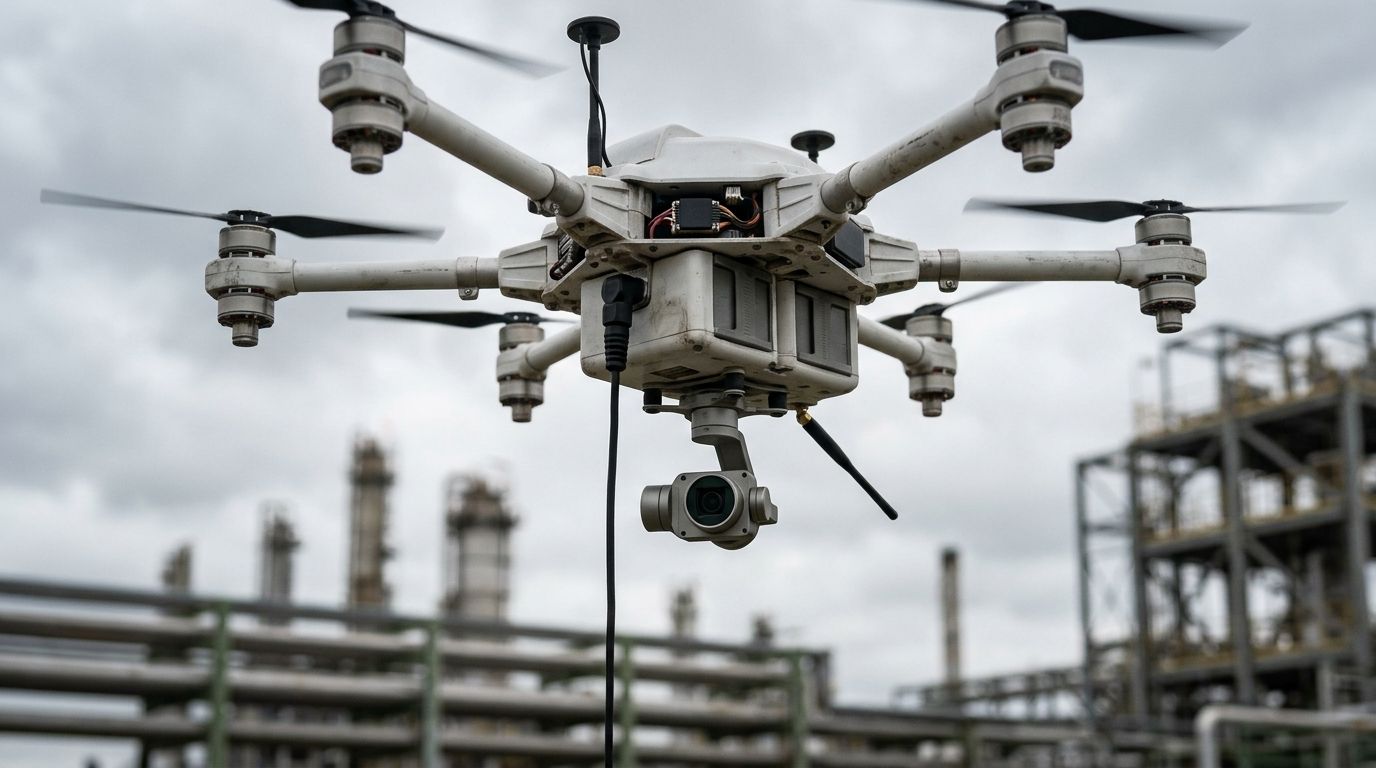
A tethered drone is connected to a ground station by a cable that supplies power and often data, so it can stay airborne far longer than a battery-powered drone. It suits persistent overwatch, temporary elevated communications and large-site situational awareness rather than long-range inspection flights.
How Tethered Drones Work
A tethered system has three parts: the aircraft, the tether and the ground station.
- The aircraft. Usually a multirotor carrying a payload: a camera (often with zoom and thermal), a radio, a cellular or private 5G small cell, a loudspeaker or lights. Most carry a small onboard battery so they can land safely if ground power fails.
- The tether. A lightweight cable that carries power up to the aircraft and, on many systems, data down over fiber or copper. Because video and control travel through the cable, there is no radio link to jam, intercept or lose behind steel.
- The ground station. A powered winch that pays out and reels in the tether, keeps it at the right tension and converts ground power (generator, vehicle, grid or a battery bank) to what the aircraft needs. Many ground stations mount on a vehicle or trailer.
In operation, the drone climbs to a set height and holds position. Flight time is limited by the ground power supply and maintenance intervals, not by a battery, so hours-long and even multi-day flights are realistic. The trade-off is obvious: it cannot go anywhere the tether will not reach.
Tethered vs Free-Flying Drones
The choice is not about which drone is better. It is about whether the job is to stay or to travel.
- Endurance. Tethered: hours, limited by ground power. Free-flying: typically 20 to 45 minutes per battery.
- Range. Tethered: a fixed point, a few hundred feet up. Free-flying: miles, subject to line-of-sight rules.
- Data link. Tethered: wired, secure and high bandwidth. Free-flying: radio, which can drop out or be interfered with.
- Wind and stability. Tethered: the cable adds stability and a hard limit on drift. Free-flying: more sensitive to gusts, especially at the end of a battery.
- Operator workload. Tethered: largely automated hover, so one operator can manage it alongside other duties. Free-flying: active piloting and battery management.
- Best for. Tethered: overwatch, elevated radios, events, incidents. Free-flying: inspection, mapping, surveys and anything that moves.
Many programs run both. A tethered aircraft holds the overview while a free-flying drone goes in close for inspection or search.
Industrial and Incident Use Cases
Persistent overwatch on large sites
Refinery turnarounds, laydown yards, data center builds and solar farms cover more ground than a few fixed cameras can see. A tethered drone at a few hundred feet sees over pipe racks, cranes and stacked materials, and feeds the same video monitoring and analytics as the ground cameras. Pair it with edge AI perimeter detection and the aerial view becomes alerts, not just footage.
Temporary elevated communications
Radio coverage is mostly a height problem. Lifting an antenna from a 30-foot mast to a tethered aircraft at a few hundred feet can extend line-of-sight coverage dramatically, which helps on sprawling sites, in valleys and where structures block the signal. A tethered aircraft can carry a private 5G or LTE radio, a Wi-Fi access point or a push-to-talk repeater.
Incident response
During a fire, release or structural failure, incident command needs a stable view of the whole scene, often for many hours. A tethered drone gives a continuous aerial feed from a safe stand-off distance, with thermal imaging to track hot spots and plume direction. It also does not need to land every half hour while the situation is changing.
Disaster and storm restoration
When towers and grid power are down, a tethered aircraft over a staging area can provide temporary coverage and a view of the damaged corridor. See how this fits with disaster response connectivity and storm restoration.
Events and crowds
Festivals, races and large gatherings need security overwatch and extra network capacity at the same time, often in the same spot. One tethered platform can carry both.
Where a tethered drone is the wrong tool: pipeline or power line patrols, flare stack and tank inspections, stockpile volumetrics, and anything that requires covering distance. Use a free-flying drone for those.
Regulatory Considerations (Verify Current FAA Rules)
Drone rules change, and this section is a starting checklist, not legal advice. Confirm current requirements with the FAA and your aviation counsel before every program.
- A tethered drone is still a drone. In the United States, the FAA generally treats tethered small unmanned aircraft as aircraft, so commercial flights typically fall under Part 107, including a certificated remote pilot and registration.
- Altitude. Part 107 limits flights to 400 feet above ground level, or higher within 400 feet of a structure. Flying above that needs a waiver.
- Controlled airspace. Sites near airports usually need airspace authorization, often available through LAANC. Plan ahead for sites in or near Class B, C or D airspace and around temporary flight restrictions.
- Operations over people and at night. Both are allowed under conditions that depend on the aircraft and its equipment. Events and active work areas need careful planning.
- Radio payloads. Lifting a transmitter changes its coverage and can raise interference concerns, so check FCC rules and spectrum authorizations for the specific band. For CBRS, antenna height is part of the device registration.
- Site rules. Refineries and chemical plants often have their own requirements for equipment in hazardous areas, hot work, and flights over process units. Get site safety approval early.
Integration with a Command Center
A tethered drone is only useful if its feed and its radios connect to something. On its own, it is a camera on a string. The value comes when it plugs into the same command post as the rest of the site.
- Power and launch point. The ground station needs steady power and a clear launch area. A mobile command center with battery, shore power and generator supplies both.
- Video into the same system. The aerial feed should land in the same NVR and analytics stack as the ground cameras, so operators see one picture and alerts apply to both.
- Radios into the same network. A radio carried aloft should extend the site network, not create a separate one. Devices should roam between the mast and the aircraft without reconfiguration.
- Backhaul. Wired data from the tether still needs a path off site. LEO satellite with cellular failover keeps the feed reaching remote stakeholders.
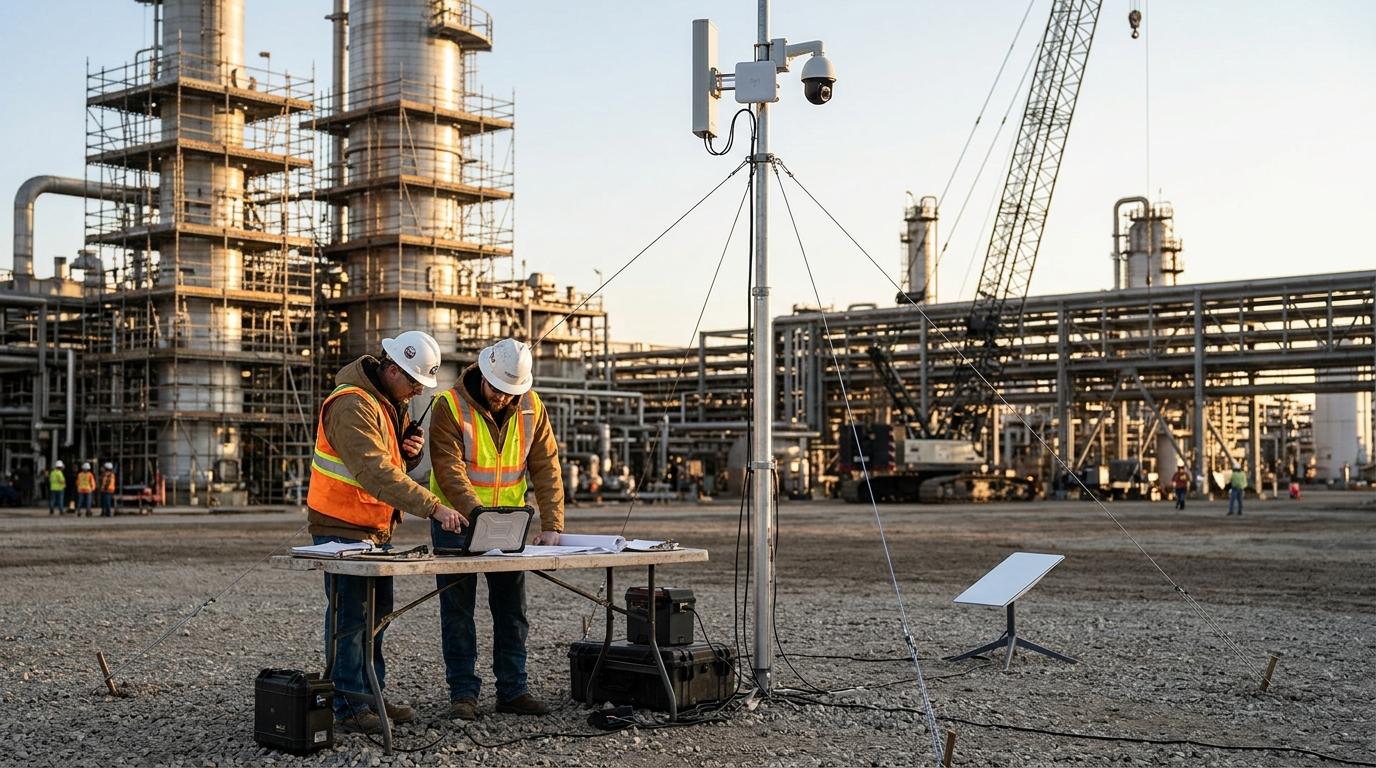
The Clover IQ Mobile Connectivity Unit is built this way. A telescoping mast of about 30 feet carries the sector antenna, Wi-Fi 6E access point, PTZ camera and license plate recognition camera for standard deployments. When a site needs more height than the mast provides, a tethered aerial platform carries radio payloads well above the mast to extend private 5G and Wi-Fi coverage, with continuous power from the unit. Video goes to the on-board NVR and edge AI server, and a Clover IQ operator runs the system on-site. Read the full breakdown in what is the Clover IQ Mobile Connectivity Unit.
Questions from the Field
How high can a tethered drone fly?
Most commercial tethered systems are designed to operate from about 100 to 400 feet, and tether length sets the physical limit. In the United States, Part 107 caps most drone flights at 400 feet above ground level unless the operator holds a waiver or is flying within 400 feet of a structure.
Do tethered drones need FAA authorization?
Generally, yes. The FAA treats tethered drones as unmanned aircraft, so commercial operations usually follow Part 107, including a certificated remote pilot, registration, and airspace authorization in controlled airspace. Rules change, so verify current FAA requirements before each program.
Can a tethered drone act as a radio or cellular relay?
Yes. Because the tether supplies continuous power, a tethered drone can carry an LTE or private 5G radio, a Wi-Fi access point or a push-to-talk repeater for hours. Raising the antenna a few hundred feet extends line-of-sight coverage. Spectrum authorization for the radio still applies.
Straight Talk
A tethered drone is not a replacement for your inspection drone, and it is not a camera you set up and forget. It is a way to put height where you need it, for as long as you need it. If the job is to watch a site through a shift or push coverage past what a mast can reach, it is the right tool. If the job is to go somewhere, it is not.
Talk to us about elevated coverage for your site. Tell us the footprint, the timeline and what needs to be seen or connected, and we will tell you whether a mast, a tethered platform or both make sense.