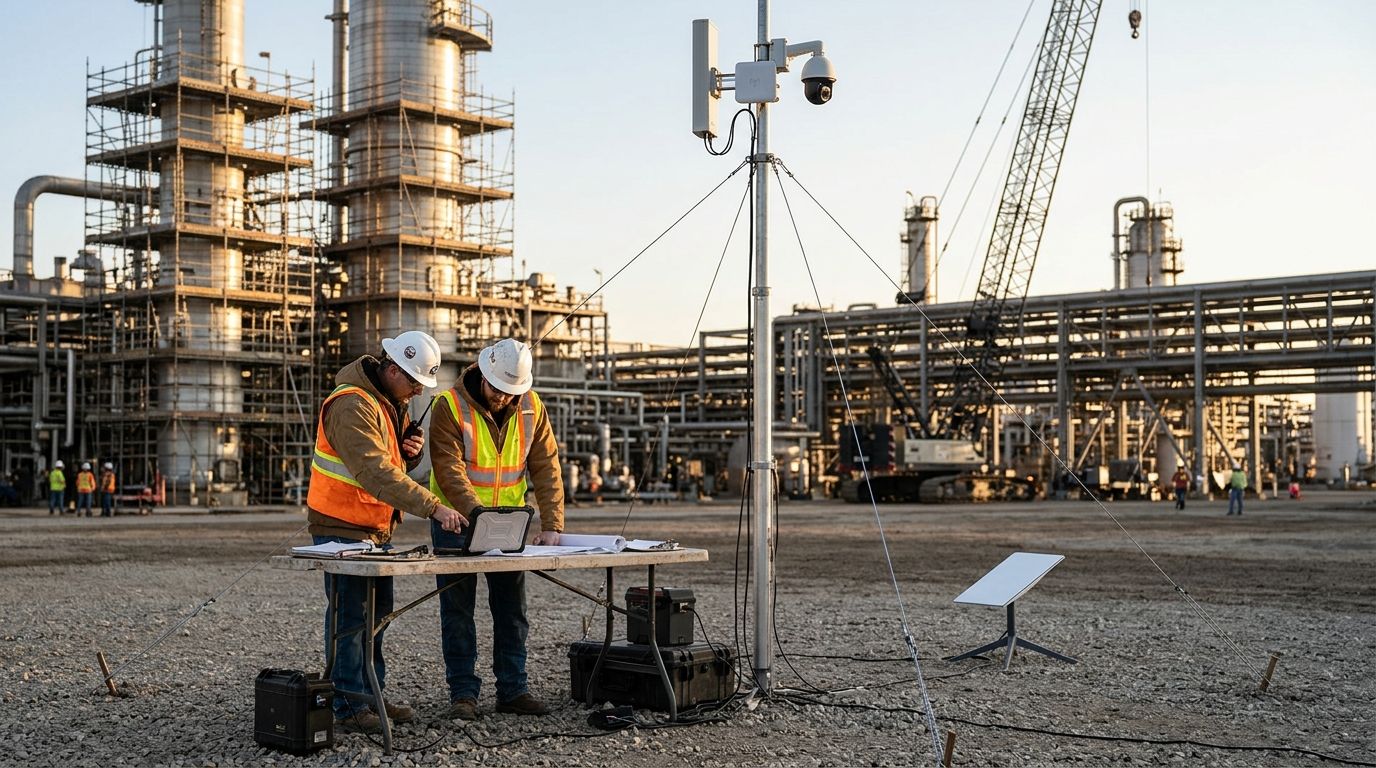
When a plant starts a turnaround, a storm takes down a substation, or a remote project breaks ground miles from the nearest tower, the first problem is rarely the work itself. It is that nobody can talk, see or coordinate. The radios do not reach, the carrier network is overloaded or gone, and the nearest building with power and a desk is the wrong side of the site.
That is the gap a mobile command center fills.
The short answer
A mobile command center is a vehicle or trailer that brings communications, power, computing and situational-awareness tools to a site. Industrial operators use them for turnarounds, remote projects and incident response; agencies use them for emergencies and events when fixed infrastructure is unavailable or overloaded.
You will also hear it called a mobile command vehicle, a deployable command post or, in our case, a mobile connectivity unit. The names differ, but the job is the same: turn an empty patch of gravel into a working command post, fast.
What's Inside a Mobile Command Center
Designs vary from a pickup with a radio rack to a 40-foot trailer with a conference room. Most capable units share five building blocks.
- Communications. Radios and push-to-talk for crews, plus a local data network (Wi-Fi, private LTE or private 5G) so phones, tablets and sensors can connect. Many units also bridge to existing land mobile radio so everyone can reach the control room.
- Backhaul. A path out to the internet and to company systems. Because a mobile command center is often deployed where ground infrastructure is missing or damaged, LEO satellite is common, usually with cellular or microwave as failover.
- Power. Onboard batteries, an inverter, a shore power inlet and a generator, with automatic transfer between them so the equipment never drops when a source changes.
- Computing and storage. Servers that run the network core, record video and run applications on-site, so the command post keeps working even if the backhaul link goes down.
- Situational awareness. Cameras on a mast, video analytics, maps and dashboards, displayed at operator workstations inside the vehicle.
A mast is what ties it together. Antennas and cameras need height to see over equipment, vehicles and terrain, and a telescoping mast gives you that height without building anything.
Industrial Use Cases
Industrial sites use mobile command centers when the work is temporary, the headcount spikes, or the location has no usable infrastructure.
Turnarounds and shutdowns
A refinery or chemical plant turnaround can bring hundreds of contractors onto a unit for a few weeks. A mobile command center gives the turnaround team its own network, push-to-talk and camera coverage, separate from the plant OT network. We cover the full picture in our guide to turnaround connectivity.
Remote projects
Well pads, pipelines, mines and greenfield construction often start before any fiber or carrier coverage exists. A mobile unit provides connectivity and a control room from day one, and moves when the work moves. See how this plays out on remote well pads.
Construction and data center builds
Large job sites need permits, cameras, access control and crew communications long before the permanent building network is installed.
Incident response on site
A fire, release or equipment failure can take out the plant's own communications at the worst possible moment. A mobile command center can be staged at a safe distance as a forward command post, with its own power and backhaul.
Emergency and Public Safety Use Cases
Public agencies and utilities have used mobile command vehicles for decades. The use cases are familiar:
- Natural disasters. Hurricanes, floods and wildfires knock out cell towers and grid power. A command post with satellite backhaul and its own power restores coordination for responders. We go deeper in disaster response connectivity when carriers and grid fail.
- Utility storm restoration. Crews advance through a damaged corridor, and the staging area needs connectivity that follows them. See our post on storm restoration and substation connectivity.
- Large events. Festivals, races and stadium events overload public networks exactly when security and operations need them most.
- Search and rescue and law enforcement. A forward command post with cameras, maps and radio interoperability, close to the scene.
The common thread is the same as on industrial sites: fixed infrastructure is unavailable, overloaded or not where you need it.
Rent vs Own
Owning a mobile command center makes sense for some organizations, but it is a bigger commitment than the vehicle price suggests.
Owning
Fits agencies and operators that deploy often, need the unit on standby at all times, and have staff to maintain it. The real costs are ongoing: radio and network maintenance, software and security updates, satellite subscriptions, spectrum and licensing, vehicle upkeep, and trained people who know how to set it up under pressure. A unit that sits for months between incidents tends to have dead batteries and expired firmware on the day it is needed.
Renting or using a service
Fits operators with planned, temporary needs such as turnarounds, projects and seasonal events, or who want standby capacity for incidents without carrying the asset. The best options include people, not just hardware: engineers who configure the network for your site before arrival and operate it during the work. We explain why that matters in operated deployment vs hardware drop-off.
A simple test: if you would use the unit fewer than a few times a year, or you do not have a team to keep it ready, renting or a retainer is usually the better fit.
Example: The Clover IQ Mobile Command Van
The Clover IQ Mobile Connectivity Unit is a mobile command center built for industrial sites. It is a high-roof, extended-wheelbase Sprinter-based van with a standing-height workspace and three equipment racks:
- Rack 1, Telecom Core: a private 5G core on CBRS Band 48, multi-WAN router and firewall, PoE++ switch, on-prem push-to-talk server, microwave link, and rack UPS.
- Rack 2, Edge AI and Video Analytics: an NVIDIA L4 GPU edge server, 32-channel NVR and 48 TB of storage for video monitoring and analytics that stays on-site.
- Rack 3, AI Workloads: a datacenter-class GPU server for local AI inference, sensor fusion and custom industrial workloads, with no cloud round-trip.
A telescoping mast carries the private 5G sector antenna, a Wi-Fi 6E access point, a PTZ camera and a license plate recognition camera. Backhaul runs over Starlink Flat High Performance satellite, with cellular and microwave as failover. Inside, a three-station control room gives the operations team workstations, monitors and a KVM, and rooftop HVAC keeps the racks cool in the heat.
The van is operated by a Clover IQ team, not dropped off. Configuration, spectrum registration and the talkgroup plan are done before arrival, and an operator is on-site during active shifts for full-command engagements. Read the full walkthrough in what is the Clover IQ Mobile Connectivity Unit.
Questions from the Field
How fast can a mobile command center be operational?
It depends on the unit and how much preparation is done before it arrives. The Clover IQ Mobile Connectivity Unit has its private 5G network live within one hour of reaching position. For a full-command deployment with cameras, analytics and push-to-talk, full site handoff completes within eight hours.
Can it work where there's no cell coverage?
Yes, if it carries its own backhaul and local network. The Clover IQ unit uses Starlink satellite backhaul with cellular and microwave failover, and builds its own private 5G and Wi-Fi network on-site. Its push-to-talk server runs locally, so crew voice keeps working even if the internet link drops.
How is it powered?
The Clover IQ unit runs its full load (racks, control room, mast and climate) from onboard battery, a 50 A shore power inlet or a diesel backup generator. A 5 kW inverter/charger switches between sources automatically, so it can run silently on battery where noise matters and on generator where runtime does.
Straight Talk
A mobile command center is only as good as the network, power and people inside it. A truck full of equipment that takes a day to set up, or that nobody on site knows how to run, is not a command post. It is a parked vehicle. Ask any provider how long until crews can talk, what happens when the backhaul drops, and who is on-site to fix it.
Request a demo of the Mobile Command Van. Tell us your site, your timeline and what has to work on day one, and we will show you how the unit fits.


