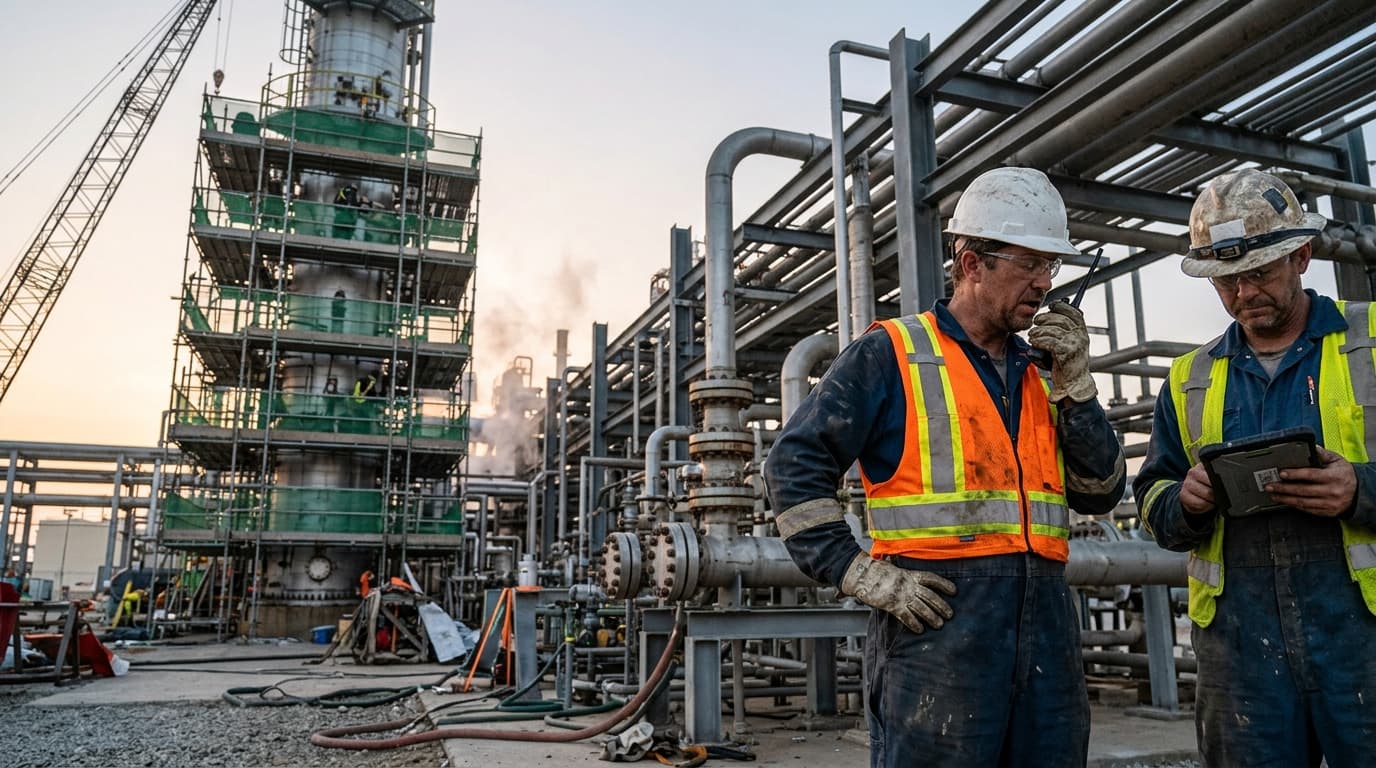
On a normal day, the plant radio system is quiet. Operators check in with the control room, maintenance calls for a permit, and the Wi-Fi carries a few dozen laptops. Then the turnaround starts, 750 contractors walk through the gate at 6am, and by 6:30 nobody can get a word in on the radio and the permit tablets are spinning.
Nothing failed. The network just did what it was designed for, and it was never designed for this. This post walks through how we size radio and data capacity for turnaround peak headcount, with a worked example you can adapt to your own site.
The short answer
Size for peak headcount, not normal operations. Count users by crew and role, map talkgroups, estimate simultaneous data users (tablets, cameras, permit apps), then check channel capacity, coverage in congested units and backhaul. Validate with a survey and load test before mobilization.
Why Normal-Day Networks Fail at Peak
A turnaround changes almost every number the plant network was built around.
- Headcount multiplies. A unit that runs on 150 permanent staff can host 500 to 1,000 or more people at peak. The radio system and access points have not changed.
- Everyone arrives at once. Load does not ramp up gently. It spikes at shift change, at the morning toolbox talk, and at lunch, when hundreds of devices join the network in the same 20 minutes.
- The traffic mix changes. Normal operations are mostly voice. A turnaround adds digital permits, photo and video uploads, CMMS updates, video calls with vendors, and cameras streaming from the units.
- The site itself changes. Scaffolding, temporary buildings, cranes and opened equipment block and reflect signal. Coverage that was fine last month can drop out inside a unit full of new steel.
- Contractors bring their own gear. Radios on unknown frequencies, personal hotspots and unmanaged devices all add interference and noise.
That is why capacity planning belongs on the turnaround timeline, around 10 to 12 weeks before mobilization. We cover the full backward schedule in our turnaround communications plan.
Counting Users and Talkgroups
Every capacity number starts with a headcount. Pull the turnaround headcount curve and contractor list, then build a simple table by crew and role. For each line, write down:
- Who: the contractor or craft, and their unit or work area.
- How many, by shift: peak day shift and peak night shift, not the turnaround average.
- Which devices: radio, phone, tablet, gas monitor, body camera or wearable. Many people carry two or three.
- Which talkgroups they need: their own crew, the unit, and the shared channels.
- Where they work: and the hazardous area classification there, because that decides which intrinsically safe devices they can carry.
Talkgroups follow from that table. A common structure is one talkgroup per major contractor or craft in each area, plus shared groups that cut across the whole site: operations and the control room, emergency, crane and lift coordination, firewatch, permit office, and security at the gate. The emergency talkgroup should be reachable from every radio, with nothing else on it.
Two rules keep the plan usable. First, do not put more than one busy crew on a talkgroup, or people will step on each other during hot work and lifts. Second, keep the number of talkgroups a person must monitor small. A radio that scans eight busy channels is a radio nobody listens to.
Voice Capacity: LMR and PTT over Cellular
Talkgroups are not the same as capacity. What matters is how many calls happen at the same moment, and whether the system has enough voice paths to carry them.
Land mobile radio (LMR)
On a trunked LMR system, each simultaneous call uses a voice path: a channel, or a timeslot on a digital channel. If 12 talkgroups key up at the same moment and the site only has 8 voice paths, 4 crews hear a busy tone. Count the peak simultaneous calls you expect, add headroom, and check that against the channels you have licensed and the repeaters that serve each unit. Conventional (non-trunked) channels are simpler, but every busy crew needs its own channel.
PTT over cellular
Push-to-talk over cellular (PoC) carries voice as data over LTE, 5G or Wi-Fi. Each call uses very little bandwidth, so the limit is usually not raw capacity but latency and priority: PTT traffic needs to be prioritized over video and file uploads so it stays instant when the network is busy. On a private network you control that priority. On a public carrier network during a big turnaround, you usually do not.
Most sites end up with both. Operations keep the plant LMR system, contractors use push-to-talk devices on the temporary network, and a radio gateway bridges the two so the control room can reach every crew. Test that bridge early. It is the link the emergency plan depends on.
Data Capacity: Wi-Fi, LTE and Backhaul
Data sizing starts with how many devices are active at the same time, not how many are on the site. A tablet in a pocket uses almost nothing. A camera streams all shift. Split devices into three groups:
- Light users: permit apps, checklists, messaging and email. Short bursts, low bandwidth, but very sensitive to coverage gaps and timeouts.
- Heavy users: photo and video uploads, video calls with vendors and engineers, and document downloads.
- Always-on streams: fixed and body cameras, sensors and gas monitors. Mostly uplink traffic, which is the direction most networks are weakest in.
Then size each layer:
Wi-Fi
Plan industrial Wi-Fi by active clients per access point, not by square footage. In dense areas like the contractor village, the permit office and the gate, you will need more access points than coverage alone would suggest.
Private LTE or 5G
Cellular covers the units and laydown areas with fewer radios and handles moving users better. Check uplink capacity per cell against the cameras and uploads in that area, and plan cell coverage for the inside of congested units, not the road beside them.
Backhaul
Everything above lands on backhaul to the internet and to plant systems. Add up the busy-hour traffic, leave headroom for growth during the turnaround, and plan a failover path. A single fiber link or cellular modem is a single point of failure for every permit on site.
Do not forget the quiet limits. DHCP address pools, authentication servers and firewall session tables are often sized for normal operations and run out at the first shift change.
Illustrative Worked Example
The numbers below are illustrative, not a design. They show how the pieces fit together for a mid-sized refinery turnaround.
Headcount
150 permanent staff plus 750 contractors at peak day shift, and 350 on nights. Peak design load is about 900 people on day shift.
Talkgroups
12 contractors working across 3 units gives about 24 crew talkgroups once each large crew is split by area. Add operations, emergency, crane and lift, firewatch, permits and security, and the plan has about 30 talkgroups.
Voice
During a lift or a hot-work window, assume a third of the talkgroups are active at the same moment. That is about 10 simultaneous calls, so plan voice paths for at least that plus headroom, and keep the emergency talkgroup on a path that is never shared.
Data devices
About 300 tablets and phones in use, roughly half active in the busy hour, plus 20 cameras streaming from the units and laydown yards.
Backhaul
If 150 active devices average 0.5 Mbps and 20 cameras send 3 Mbps each, the busy hour needs around 135 Mbps, mostly uplink from the cameras. Designing for about twice that, with a separate failover link, gives room for the video calls and surges nobody predicted.
Your numbers will differ, but the method holds: headcount by shift, talkgroups by crew, simultaneous calls, active devices, then backhaul with headroom.
Validation and Testing
A spreadsheet is a hypothesis. Before mobilization, prove it.
- Survey first. A site survey and RF design measures existing coverage and interference in each unit, laydown area and the contractor village. We explain why the survey is worth paying for in paid site surveys vs. complimentary RF walkthroughs.
- Test where the work happens. At the bottom of a column, inside vessel entry zones, under the pipe rack and at the far corner of the laydown yard. Repeat after scaffolding goes up if you can.
- Load test the busy hour. Join a realistic number of devices at once, stream cameras, run permit sign-offs and key up several talkgroups together. Watch latency, dropped calls and failed logins.
- Test the bridge and the emergency call. Confirm the control room can reach every crew, and that an emergency call gets through while the network is loaded.
- Monitor through peak. Capacity needs change as headcount climbs and work moves between units. Check daily and adjust coverage before crews notice.
How Clover IQ Helps
Clover IQ sizes, deploys and operates temporary networks for turnarounds. We build the talkgroup plan and capacity model from your headcount curve, survey the site, and bring the Mobile Connectivity Unit with its own power, backhaul, private 5G, Wi-Fi and on-prem push-to-talk, so turnaround load stays off the plant network. Need devices too? Our rental fleet includes intrinsically safe phones, tablets and radios, enrolled and configured before they arrive. See turnaround infrastructure as a service for the full package.
Questions from the Field
How many talkgroups does a turnaround need?
There is no fixed number. Start with one talkgroup per major contractor or craft in each work area, then add shared groups for operations and the control room, emergency, crane and lift, firewatch, permits and security. A mid-sized refinery turnaround often lands somewhere between 20 and 40 talkgroups.
Can contractors bring their own radios?
Sometimes, but only on the site's terms. Their radios must be programmed to the site talkgroup plan and frequencies, carry the right intrinsically safe rating for the area, and reach the emergency talkgroup and the control room. Many sites program contractor radios at the gate or issue site radios instead, to avoid interference and gaps in the emergency plan.
What is PTT over cellular?
Push-to-talk over cellular (PoC) is walkie-talkie style voice carried as data over LTE, 5G or Wi-Fi instead of a dedicated radio channel. It works on phones or rugged PTT handsets, covers wherever the network reaches, and can be bridged to existing LMR radios through a gateway. On a private network, PTT traffic can be prioritized over other data.
Straight Talk
Turnaround networks rarely fail because of one bad radio. They fail because nobody counted how many people would be talking, streaming and uploading at 6:30 on day three. The math is not hard. It just has to be done before the gate opens.
Book a 30-minute discovery call. Bring your headcount curve and unit list, and we'll sketch the talkgroup plan and capacity you need for peak.